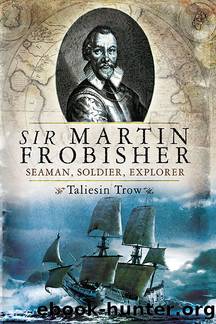
Sir Martin Frobisher by Taliesin Trow
Author:Taliesin Trow
Language: eng
Format: epub
Tags: Bisac Code 1: TRA006010
ISBN: eBook ISBN: 9781844684168
Publisher: Pen & Sword Books
Published: 2011-02-23T00:00:00+00:00
Chapter 7
Foolâs Gold
By the time Frobisher appeared before Queen Elizabeth again he had clearly become a royal favourite, and this went to his head. A report on all three voyages compiled for the State Papers highlights this: âHereupon, Frobisher grew into such a monstrous mind, that a whole kingdom could not contain it, but already, by discovery of a new world, he was become another Columbus.â1 Before he left on his third voyage, the Queen gave him a generous gift of a large gold chain. He had presented her with the famed narwhal tusk, a rich prize and something that was irksome to the financially minded Lok. Frobisher was once again the focus of attention at court and delighted people with tales of his exploits, which doubtless swelled his ego further. He was a celebrity, finally gaining the admiration and recognition he had been craving.
The three captives brought back were once again a fascination. They remained in Bristol â already assuming a new importance because of its position in the west in the context of the New World â but did not survive long enough to be presented to the Queen, something that disappointed the doctor who examined them more than their actual deaths. Dr Edward Donningeâs two-page report, written in Latin as was still usually the practice amongst medical men, still survives. According to Best: âwhen he founde himself in captivitie, for very choller and disdain, he bit his tong in twayne within his mouthâ.2
Whilst in Bristol, the Inuit were observed by the public as an entertainment. Seyerâs Annals of Bristol, compiled from earlier documents in the 1790s, reported Frobisherâs return to Kingrode (the entrance to Bristol Harbour) âfrom Cattaiâ. He brought ore: âesteemed to be very ritch and full of gowlde. It was heavy and so hard that it would strike fire like flint.â3 Of more immediate interest were Frobisherâs captives: âCallicho and a woman called Ignorth [sic]. They were savage people and fed only upon raw flesh.â4
Kalicho took to the Avon in his 14ft kayak and began hunting mallard as he would have hunted seabirds in his Arctic home â âhe would hit a ducke a good distance and not misseâ.5 The women of England, who had perhaps applied a little lead-based make-up in the fashion of their white-faced monarch, were fascinated by the blue-delineated tattoos on Arnaqâs face. The water-colourist John White, who was to join Ralegh on his voyages to North America where he would sketch Indians, flora and fauna, found in the Inuit captives his new fascination. The images, clearly the most famous, are very detailed, down to the seams on Kalichoâs hide jacket. He also depicted the decisive âbattleâ at Bloody Point from hearing the tales of the returning adventurers. As with the previous captive, the three Inuit did not survive more than a few months. Kalicho, it is presumed, died from a collapsed lung, having developed breathing problems earlier as a result of sustaining two broken ribs perhaps during his capture by Nicholas Conger.
Download
This site does not store any files on its server. We only index and link to content provided by other sites. Please contact the content providers to delete copyright contents if any and email us, we'll remove relevant links or contents immediately.
| Africa | Americas |
| Arctic & Antarctica | Asia |
| Australia & Oceania | Europe |
| Middle East | Russia |
| United States | World |
| Ancient Civilizations | Military |
| Historical Study & Educational Resources |
The Dawn of Everything by David Graeber & David Wengrow(1708)
The Bomber Mafia by Malcolm Gladwell(1625)
Facing the Mountain by Daniel James Brown(1556)
Submerged Prehistory by Benjamin Jonathan; & Clive Bonsall & Catriona Pickard & Anders Fischer(1457)
Wandering in Strange Lands by Morgan Jerkins(1430)
Tip Top by Bill James(1417)
Driving While Brown: Sheriff Joe Arpaio Versus the Latino Resistance by Terry Greene Sterling & Jude Joffe-Block(1377)
Red Roulette : An Insider's Story of Wealth, Power, Corruption, and Vengeance in Today's China (9781982156176) by Shum Desmond(1359)
Evil Geniuses: The Unmaking of America: A Recent History by Kurt Andersen(1354)
The Way of Fire and Ice: The Living Tradition of Norse Paganism by Ryan Smith(1338)
American Kompromat by Craig Unger(1320)
F*cking History by The Captain(1305)
It Was All a Lie by Stuart Stevens;(1301)
American Dreams by Unknown(1288)
Treasure Islands: Tax Havens and the Men who Stole the World by Nicholas Shaxson(1274)
Evil Geniuses by Kurt Andersen(1257)
White House Inc. by Dan Alexander(1212)
The First Conspiracy by Brad Meltzer & Josh Mensch(1174)
The Fifteen Biggest Lies about the Economy: And Everything Else the Right Doesn't Want You to Know about Taxes, Jobs, and Corporate America by Joshua Holland(1126)
